The Hidden Highway. Why Sealing Curtain Wall Gaps Is Non-Negotiable for Fire Safety
Why Perimeter Barriers Are Not Optional
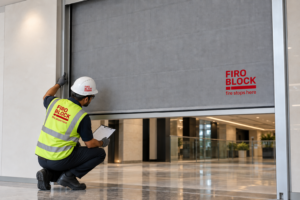
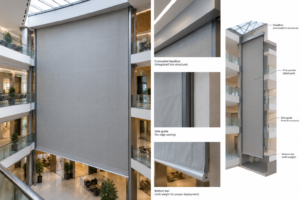
High-rise and commercial buildings are marvels of modern engineering, but their design also introduces subtle paths for fire and smoke to travel. One of the most influential is the slab edge, the junction where the floor meets the curtain wall. Without a robust Curtainwall firestop and perimeter Barrier system like Firoblock, fire and smoke can move with surprising speed through hidden voids, turning a local incident into a multi-floor emergency.
The perimeter gap at the slab edge between the floor and the curtain wall is often out of sight, yet it can become a fast escape route for heat, flame, and smoke when it is left unprotected. This is the story the headlines rarely tell, until a fire breaks out.
1 The Perimeter Gap Problem
A perimeter gap is a deliberate void left at the junction of the floor slab and the curtain wall to allow for structural movement, thermal expansion, and shifts during seismic events. But every gap is a ready-made path.
When this void is left unprotected, fire does what it always does. It looks for weakness. In minutes, flames and choking smoke can bypass solid slab divisions, traveling internally via the Chimney Effect or externally through Leapfrogging, defeating years of careful planning.
Most building codes now demand perimeter Barriers and certified Curtainwall firestop products like Firoblock because real-world tragedies showed how disastrous things get when those lines are ignored.
2 The Chimney Effect
Fire does not just spread across a room. It also moves vertically. When a fire grows, hot gases rise and create pressure differences. If the slab edge gap is unprotected, it behaves like a vertical shaft behind the curtain wall.
Smoke and heat rise through concealed voids
Upper floors are affected even when slabs should contain fire
Fire spread becomes hidden and difficult to control
3 Leapfrogging
Leapfrogging is external fire spread. Flames exit through broken glazing, travel upward along the facade, and re-enter through upper floors.
Flames break out from the fire floor
Heat damages glazing above
Fire re-enters at higher levels
Unprotected perimeter gaps allow fire to bypass compartmentation, turning isolated incidents into vertical spread events within minutes.
4 Why This Matters
Modern glass buildings increase exposure due to continuous facades, larger floor plates, and greater structural movement. These factors increase the importance of perimeter protection.
Longer facade perimeters increase risk exposure
Larger gaps accommodate movement but enable spread
Continuous glazing reduces natural fire breaks
5 The Solution
Tested and certified Curtainwall firestop and perimeter Barrier systems are required to maintain compartmentation and control smoke movement.
Maintain fire resistance at slab edge
Prevent vertical and lateral fire spread
Support smoke sealing at perimeter
Systems like Firoblock are designed to maintain continuity at the slab edge while allowing movement, ensuring that this critical junction does not become a failure point during a fire.