
Fire safing insulation is the material that fills the gap between a floor slab and a curtain wall. It looks simple, but small choices about material, density and fitting decide whether it holds in a fire. This guide explains what fire safing insulation is, why mineral wool is used, how density, compression and foil facings affect performance, and why safing on its own is not a tested system. It is written for facade consultants, contractors and site engineers. For the wider system, start with our complete guide to slab edge protection.
Key Takeaways
- Fire safing insulation is usually non combustible mineral wool fitted under compression in the slab edge gap.
- Density, fibre orientation, compression and facings all affect how mineral wool fire safing behaves in a fire.
- Safing insulation is one component; performance belongs to the complete tested perimeter barrier assembly.
What Fire Safing Insulation Is
Safing is the insulation that closes the void between the slab edge and the inside face of the facade. It is the main body of the perimeter fire barrier.
In a curtain wall building, a gap is left between each floor slab and the facade. Fire safing insulation fills that gap along the whole perimeter. Its job is to restrict the passage of flames and hot gases from one floor to the next. It does this together with supports, seals and the surrounding facade construction.
In the FiroBlock system, the slab edge firestop FIROBLOCK FS performs this role. FiroBlock describes it as the heart of its barrier system, designed to seal the floor to facade gap and maintain compartmentation in curtain wall assemblies. You can see how it fits with the other parts on our FS, MP and SP product page.
Fire safing insulation is different from the thermal insulation in a wall or roof. Thermal insulation is chosen for energy performance. Safing is chosen for fire performance at a specific joint, and it must stay in place while the facade and slab heat up and move. Mixing up the two is a common mistake on busy sites, especially when both arrive in similar packs. Clear labels and a quick check at delivery prevent it.
Why Mineral Wool Is Used
Perimeter barriers rely on materials that do not burn and that stay in place at high temperatures. That is why mineral wool is the usual choice.
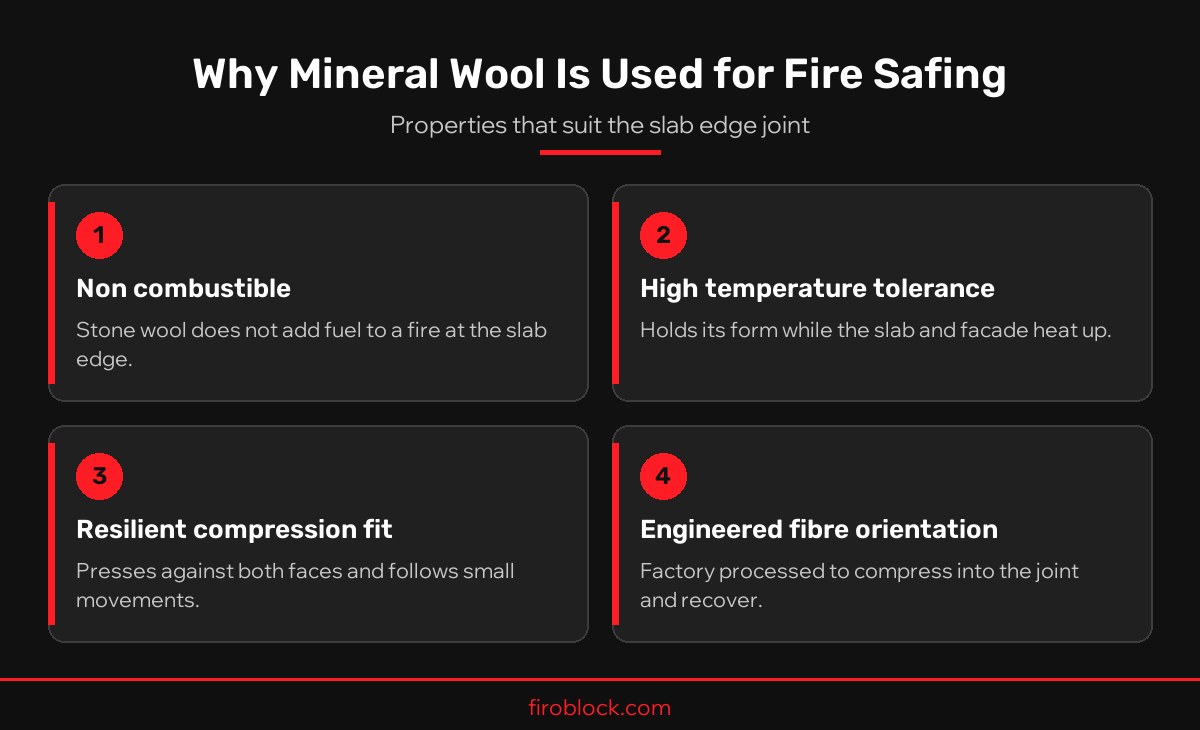
Mineral wool is made by spinning molten mineral or rock into fibres, which are then formed into slabs or boards. Stone wool types are non combustible and tolerate high temperatures, which suits the slab edge. FiroBlock describes its safing product as high density, non combustible mineral wool, with fibre orientation engineered through a specialised factory process to meet specific performance requirements.
Mineral wool fire safing has another useful property. It is resilient. When it is cut slightly wider than the gap and pushed into place, it presses against the slab and the facade. This compression fit helps it follow small movements of the facade without opening gaps. FiroBlock notes that its system is designed for both static and dynamic joint applications.
Density, Compression, Facings and Supports
Not all mineral wool fire safing performs the same way at the slab edge. Its density, compression, fibre orientation, facings and supports all deserve attention on drawings and on site.
Density affects how the material holds its shape and resists heat. Perimeter barrier products use higher density slabs than general insulation. FiroBlock publishes a nominal density of 160 kg/m³ for its MP mullion protection board. For any safing product, check the density stated in the tested system documentation rather than assuming. Ask the supplier to confirm it on the delivery documents, so that what arrives on site matches what was tested.
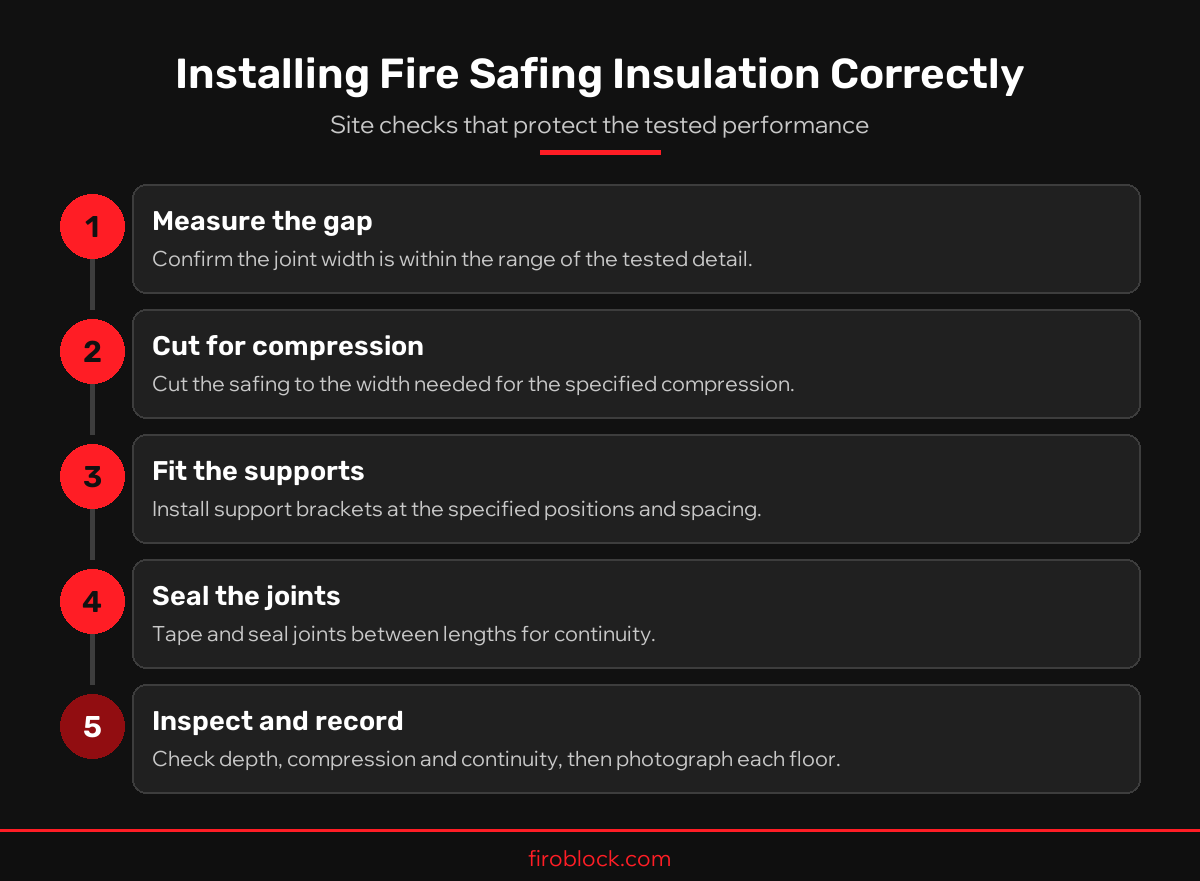
Compression is the most common site problem. If safing insulation is cut too narrow, it sits loose in the gap. Heat and movement can then open paths around it. FiroBlock states that joint dimensions, compression and facade movement must be addressed in the installation design. Inspectors should check insulation depth and compression on every floor.
Fibre orientation affects how the slab compresses and recovers. Mineral wool fire safing engineered for this joint is made so that it can be compressed into the joint and still push back against both faces. Cutting safing from a different product to save time can change this behaviour, even if the material looks similar. If an installer runs short, stop and order the correct product instead of improvising with what is on site.
The fire resistance rating of a barrier depends on all three properties working together in the tested detail. Changing one of them on site can change the result.
Facings and supports turn a slab of mineral wool into a barrier that can be installed consistently and kept in place. Both are part of the tested detail, so treat them with the same care as the insulation itself.
FIROBLOCK FS uses a non combustible mineral wool core with aluminium foil facings on both sides. FiroBlock notes that the lamination improves handling and installation. Foil also gives a clean surface that is easier to inspect and seal at joints.
Supports hold the safing insulation at the right depth. The approved FiroBlock installation uses B235 support brackets, with ATP 120 aluminium tape for support and joint continuity. Joints between lengths of safing must be tight and sealed, so that the barrier is continuous around the building. Corners and junctions need the same attention as straight runs.
Handling, Storage and Inspection on Site
Good material can still be spoiled on site. Simple handling and inspection habits protect fire safing insulation from delivery to handover.
Store mineral wool fire safing off the ground, under cover and away from water. Wet or crushed slabs may not compress and recover as designed. Keep packs labelled so that installers use the product named in the tested system, not a similar looking offcut from another trade. Check deliveries against the specification before they reach the floor.
Plan the sequence so that the safing insulation goes in after the facade is fixed but before ceilings, raised floors and services close the area. Once these trades arrive, access becomes hard and damage becomes likely. Protect finished runs, and make sure any section removed by another trade is reinstated to the same detail.
Inspect floor by floor. Check the tested system reference, the joint width, the insulation depth and compression, the supports and the sealed joints. Photograph each run with its location. These records show the fire consultant that fire safing insulation was installed as designed, and they help facility teams repair it correctly after future fit outs.
Why Safing Alone Is Not a Tested System
It is tempting to treat fire safing insulation as a product you can buy by the square metre. In practice, its performance depends on the whole assembly it is tested in.
A perimeter fire barrier is tested with a specific facade, spandrel, supports and joint width. The safing insulation is one part of that test. FiroBlock’s FS was tested with MP mullion protection and SP spandrel protection as one assembly. The rating belongs to that combination, not to the safing on its own.
So specify the system, not just the material. Name the tested assembly, state the joint width and require installation to the approved details. Our article on sealing curtain wall gaps explains why this joint matters. For a wider view, read lessons from real world fires.
Conclusion
Fire safing insulation is the core of a perimeter fire barrier, but it only works when the right material is fitted the right way. Use non combustible mineral wool from the tested system, cut it for the specified compression, support it properly and seal every joint. Remember that the rating belongs to the complete assembly with mullion and spandrel protection. FiroBlock’s FS, MP and SP system is tested as one assembly. Talk to our technical team about the right configuration for your facade.
Frequently Asked Questions
What is fire safing insulation?
It is the insulation that fills the gap between a floor slab and a curtain wall facade. It forms the main body of the perimeter fire barrier and restricts the passage of flames and hot gases between floors.
Why is mineral wool used for fire safing?
Stone wool types are non combustible and tolerate high temperatures. They are also resilient, so a compression fit presses against the slab and facade and helps the barrier follow small movements of the building.
What density should fire safing insulation have?
Use the density stated in the tested system documentation. Perimeter barrier products use higher density slabs than general insulation. FiroBlock publishes a nominal density of 160 kg/m³ for its MP mullion protection board.
Why does compression matter for safing?
Safing insulation cut too narrow sits loose in the gap. Heat and facade movement can then open paths around it. A correct fit keeps the insulation in contact with both faces of the joint during a fire.
Why do some safing products have foil facings?
Foil facings improve handling and installation and give a clean surface for inspection and sealing at joints. FIROBLOCK FS uses aluminium foil facings on both sides of its non combustible mineral wool core.
Can I use ordinary thermal insulation as fire safing?
No. Thermal insulation is chosen for energy performance. Fire safing insulation must be the product named in the tested perimeter barrier system, installed to its approved details, so that the tested performance applies to your project.
Is fire safing insulation enough on its own?
No. Performance belongs to the complete tested assembly, including supports, seals, mullion protection and spandrel protection. Specify the complete system and the joint width, not only the insulation material, in the project specification.
How long does mineral wool fire safing last?
FiroBlock states that its components are durable, non degradable and designed for the life of the building under normal conditions. Periodic inspection is still recommended as part of the building’s passive fire protection maintenance programme.
Where can I see FiroBlock’s products?
Visit the FiroBlock products page to see the curtain wall firestop system and the automatic fire curtain range, with the test references that apply to each product and its tested configurations for commercial buildings.
Why does documentation matter for safing?
Safing is hidden once ceilings and facades are closed, so it needs clear records. Learn about FiroBlock and why traceable documentation supports approvals, handover and long term maintenance of hidden fire protection in any building.