
A perimeter fire barrier tested to IS 18190 now appears in more Indian specifications for glazed buildings. Yet many project teams are unsure what the test shows and what it does not. This guide explains what IS 18190:2023 is, how it relates to ASTM E2307, why a test report is different from a certificate and which details to check in a submittal. It is written for consultants, facade engineers and contractors who review perimeter barrier evidence. For the wider system, start with our complete guide to slab edge protection.
Key Takeaways
- IS 18190:2023 is a Bureau of Indian Standards method of tests for perimeter fire barrier joint systems, not a product label.
- A perimeter fire barrier tested to IS 18190 proves performance only for the complete tested assembly, so compare the test report with your own facade before relying on it.
- Write tested to IS 18190 or ASTM E2307 in specifications unless a separate certificate from a certification body exists.
What IS 18190:2023 Covers
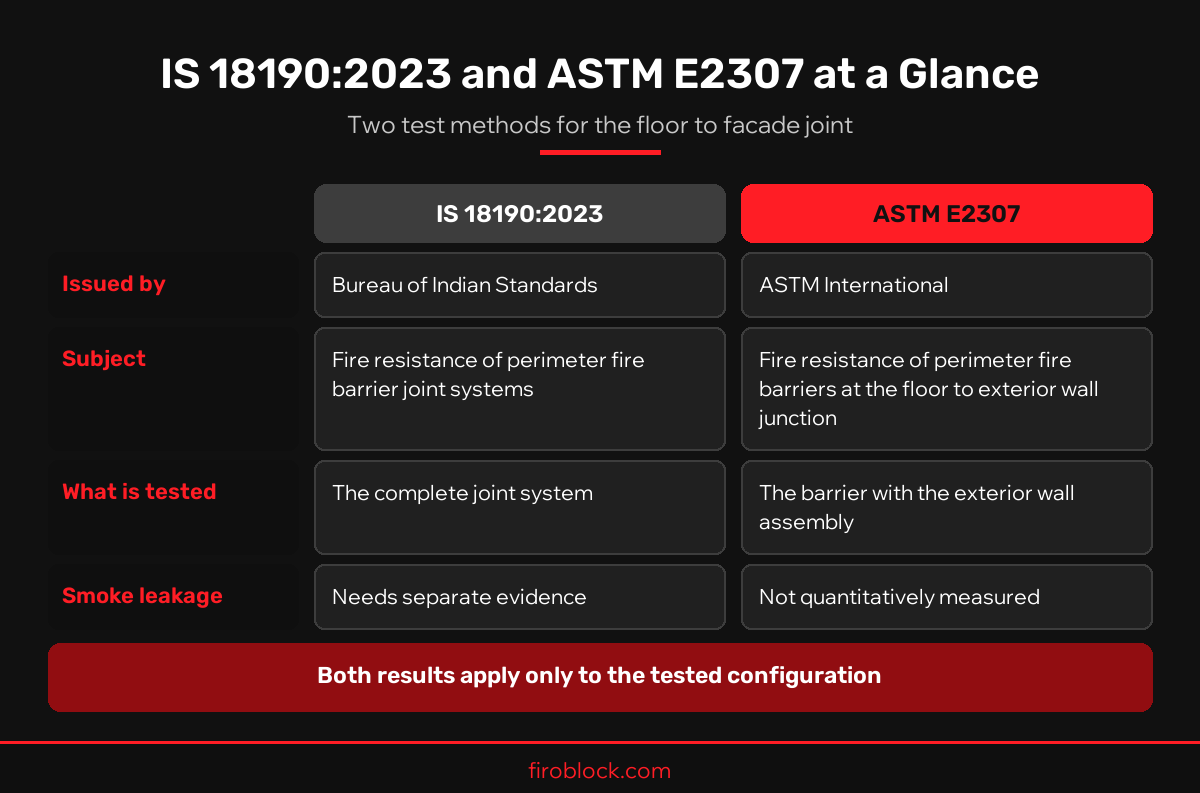
IS 18190:2023 gives Indian projects a local test method for the joint between a floor slab and an exterior curtain wall. It assesses the complete joint system, not any single material.
The Bureau of Indian Standards lists the standard as IS 18190:2023, Fire Resistance of Perimeter Fire Barrier Joint System, Method of Tests. A perimeter fire barrier joint system is the assembly that closes the gap between a fire rated floor and the facade. It usually includes insulation, safing, seals, supports and parts of the curtain wall itself.
Because the test looks at the whole joint, its evidence belongs to the tested configuration. A barrier tested to IS 18190 has shown its performance with a particular joint width, facade, spandrel and support method. Change those, and the result may no longer apply without further evidence or an assessment.
This is the main point to remember. The standard tells you how a system was tested. It does not make every product that uses similar materials compliant. Read the scope and the specimen description in the report before you rely on it.
The standard also gives Indian projects a shared language. Consultants, facade contractors and suppliers can refer to the same method when they discuss evidence. That makes tenders easier to compare and approvals easier to document. Asking for a barrier tested to IS 18190 is a clear way to state that expectation.
How IS 18190 Relates to ASTM E2307
Many curtain wall projects already refer to ASTM E2307. Knowing how the two standards sit together helps you review submittals from local and international suppliers.
ASTM E2307 is a test method that evaluates a perimeter barrier’s ability to maintain a seal and resist fire at the junction between a floor and an exterior wall assembly. It uses an intermediate scale, multi storey test apparatus. Like IS 18190, it treats the exterior wall as part of the tested assembly.
Both standards answer a similar question about the same joint. Neither one quantitatively measures smoke leakage, so a smoke claim needs its own evidence. Some systems are tested to both. FiroBlock reports that its FS, MP and SP curtain wall firestop assembly is tested to IS 18190 and ASTM E2307, with up to 120 minutes of fire resistance in the tested configuration.
When a supplier offers evidence under either standard, ask for the full report. Then check the facade type, the joint width and the spandrel build up. A system tested to IS 18190 on a different facade may not match your project, even if the duration looks right.
Test Report or Certificate: Using the Right Words
Specifications often use the word certified loosely. For perimeter barriers, the difference between testing and certification matters for approvals and for honest documentation.
A test report records what happened to a specific specimen in a laboratory. It describes the materials, dimensions, supports and results. A certificate is a separate document issued by a certification body. It usually involves ongoing checks of production and may cover a defined range of applications.
IS 18190:2023 is a method of tests. So the accurate phrase for most products is tested to IS 18190. Where certification is claimed, ask to see the certificate itself, the body that issued it and its scope.
Using precise words protects everyone. Consultants avoid approving a claim they cannot verify. Contractors avoid installing a system that does not match its evidence. Building owners receive documents that will stand up to later review.
Marketing material can blur these terms, so check the documents rather than the brochure. A data sheet that says tested to IS 18190 should point you to a report you can read in full.
What to Check in a Perimeter Fire Barrier Test Report
A good review takes less than an hour and prevents costly problems on site. Use the checks below for every submittal.
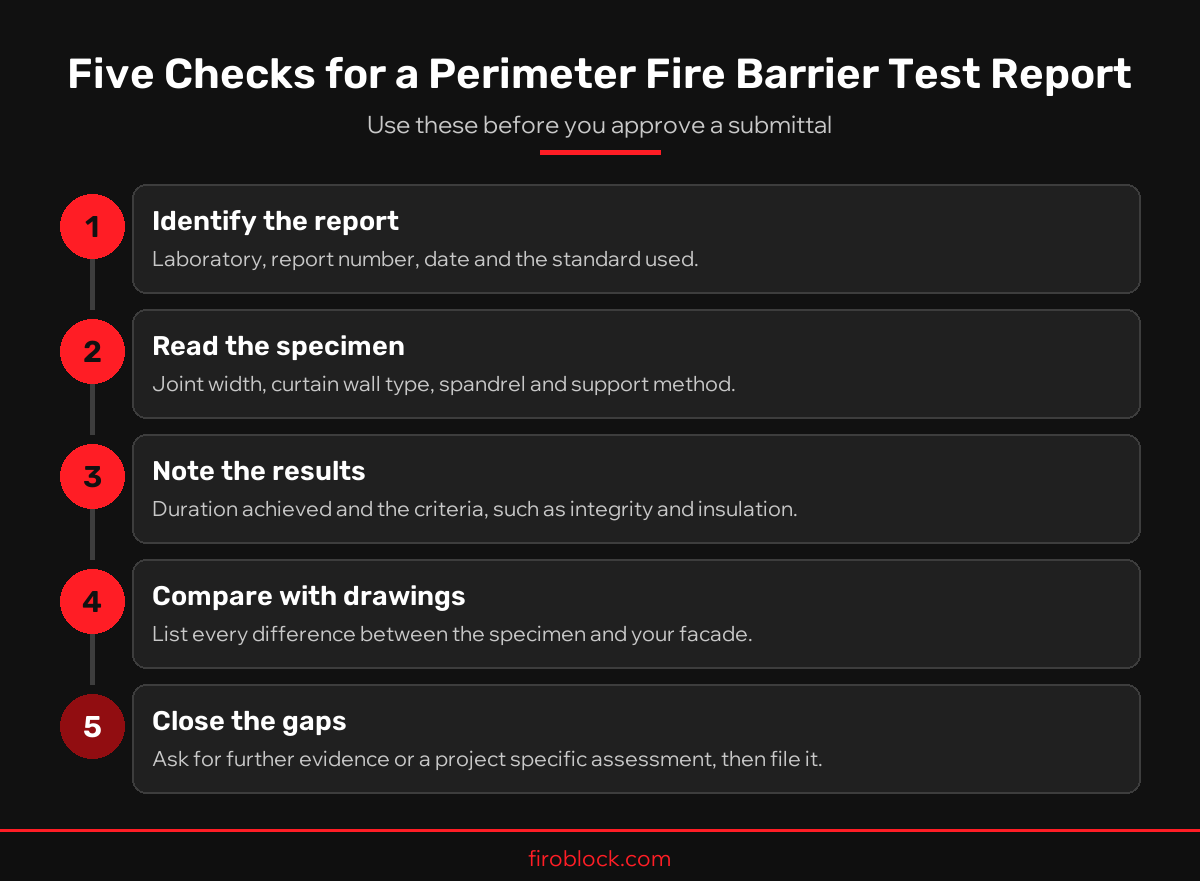
Start with the basics: the laboratory, the report number, the date and the standard used. Then read the specimen description. Note the joint width tested, the type of curtain wall, the mullion and transom positions, the spandrel materials and the support method. Compare each one with your drawings.
Next, look at the results. Note the duration achieved and the criteria used, such as integrity and insulation. Check whether the report mentions movement, and which joint dimensions and movement it covers. Finally, list every difference between the tested specimen and your project. For each difference, ask the supplier for further evidence or a project specific assessment.
Keep the report, your comparison and any assessment in the project file. At handover, these documents show the fire consultant and the building owner why the installed system is suitable for this building. Our FS, MP and SP product page shows the kind of system information to ask for. For the risk this testing addresses, read about sealing curtain wall gaps.
Writing IS 18190 Into Your Specification
A clear specification clause saves time at tender and at approval. It tells every bidder exactly what evidence you expect and how it will be checked.
Ask for a barrier tested to IS 18190 for the specific joint, and state the required fire resistance from the approved fire strategy. Describe the joint: its nominal width, tolerance and expected movement. Describe the facade: unitised or stick built, the spandrel build up and the mullion spacing. Then ask bidders to submit the full test report, not a summary.
Add a line on differences. Require bidders to list every way their tested specimen differs from your facade, and to provide further evidence or a qualified assessment for each one. This keeps the comparison fair between suppliers. It also stops a late substitution from slipping through, because any new product must meet the same clause.
Finally, link testing to installation. Require installation by trained personnel to the tested details, with inspection records and photographs for each floor. A perimeter fire barrier is only as good as the work on site. When the specification connects the report, the drawings and the inspection records, the evidence trail is complete from design to handover.
If you already have ASTM E2307 evidence in your specification, you do not need to remove it. You can ask for evidence under either standard, as long as it covers your facade. Many teams now ask for IS 18190:2023 first because it is the Indian method for this joint, and accept ASTM E2307 as supporting evidence where the configurations match.
Conclusion
A perimeter fire barrier tested to IS 18190 has shown how a complete joint system performs in a specific configuration. Read the report, compare the specimen with your facade and use the words tested to unless a real certificate exists. Where the details differ, ask for further evidence or an assessment. FiroBlock reports that its FS, MP and SP system is tested to IS 18190 and ASTM E2307. Share your facade drawings and ask our technical team for the relevant documentation.
Frequently Asked Questions
What is IS 18190?
IS 18190:2023 is a Bureau of Indian Standards method of tests for the fire resistance of perimeter fire barrier joint systems. These systems close the gap between a fire rated floor slab and an exterior curtain wall facade.
Is a perimeter fire barrier tested to IS 18190 automatically suitable for my building?
Not automatically. The result applies to the tested configuration only. Compare the joint width, facade, spandrel and supports in the report with your drawings, and ask for further evidence or an assessment where they differ.
Is IS 18190 a certification?
IS 18190:2023 is a method of tests. A product can be tested to it. Certification is a separate process run by a certification body, so ask for the certificate itself if a supplier claims one.
How is IS 18190 different from ASTM E2307?
IS 18190 is an Indian standard and ASTM E2307 is published by ASTM International. Both assess perimeter barriers at the floor to facade joint as part of an assembly. Some systems hold test evidence under both.
Does IS 18190 measure smoke leakage?
Treat smoke leakage as a separate question. Fire resistance results do not establish smoke leakage performance, so any smoke claim should be supported by its own test evidence for the system and the intended application.
What should a perimeter fire barrier test report include?
It should name the laboratory, report number, date and standard. It should describe the specimen, including joint width, facade type, spandrel and supports, and record the duration and the performance criteria achieved in the test.
What if my facade differs from the tested specimen?
Ask the supplier whether further test evidence or a qualified project specific assessment covers the difference. Do not assume the rating transfers. Record the outcome in the project file for approvals and handover.
Who reviews perimeter barrier evidence on a project?
Usually the fire consultant and the facade consultant, with input from the architect and contractor. The final acceptance rests with the authority having jurisdiction, based on the approved fire strategy and the submitted documentation.
Who is FiroBlock?
FiroBlock is an Indian passive fire protection brand backed by Super Creations, offering curtain wall firestop systems and automatic fire curtains for commercial buildings. Learn more about FiroBlock and its approach to technical support.
Why does perimeter barrier testing matter so much?
Real fires have shown how quickly flames can bypass unprotected slab edges. Read lessons from real world fires to see why tested barriers are essential for glazed buildings, and why the evidence behind them deserves careful review.